> For the complete documentation index, see [llms.txt](https://docs.charted.com/ap-automation/llms.txt). Markdown versions of documentation pages are available by appending `.md` to page URLs; this page is available as [Markdown](https://docs.charted.com/ap-automation/charted-configuration/approval-automation/enabling-approval-routing-on-record-types.md).
# Enabling Approval Routing on Record Types
### **Abstract**
To ensure vendor bills follow a structured approval process, administrators must configure *Approval Routing* at the record level in *NetSuite*. This setup allows unapproved vendor bills to remain non-posting until fully reviewed, giving finance teams control over how and when expenses are committed. For instance, if a company is transitioning from native *NetSuite* approvals to the *Charted Approval Automation SuiteBundle*, this configuration step ensures all vendor bills follow the updated approval workflow.
This article guides administrators through enabling *Approval Routing* on specific record types, particularly vendor bills.
### **Accessing Approval Routing Settings in Accounting Preferences**
To configure approval routing on a record type, administrators must first access the **Accounting Preferences** page in *NetSuite*. This area contains global controls that affect how transaction approvals behave system-wide.
Follow these steps to access and enable **Approval Routing** in **Accounting Preferences**:
1. To begin configuration, go to the top navigation menu in *NetSuite* and hover over **Setup**, then over **Accounting**, and select **Accounting Preferences** from the submenu:\
2. Once the **Accounting Preferences** page loads, navigate to the **Approval Routing** section by clicking its corresponding tab or header:\
\
\
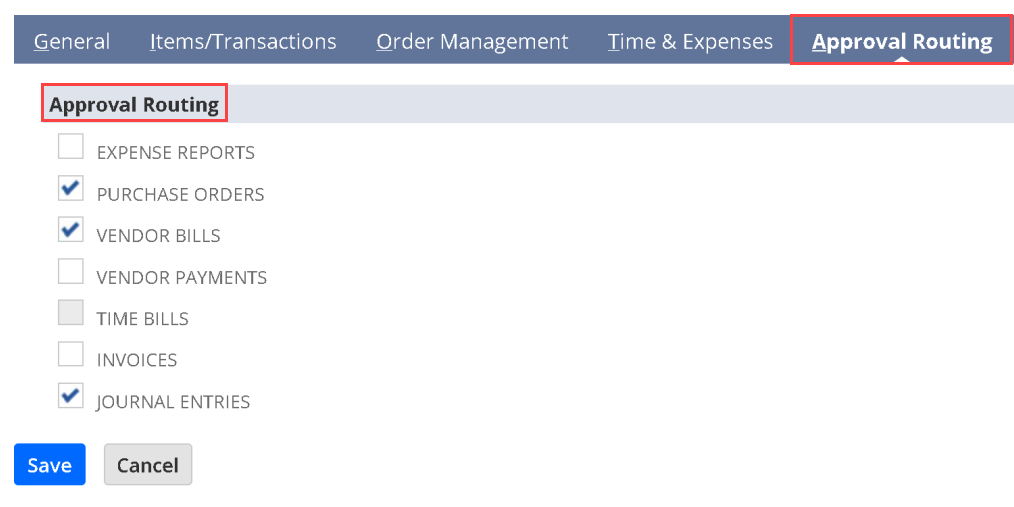
It will open a new screen for the **Approval Routing** section:\
3. To activate approval workflows for specific transaction types, locate and check the box for **Purchase Orders, Vendor Bills, Journal Entries** — or for any other applicable record type:\
4. When you’re done selecting applicable records, click the **Save** button to apply your changes and enable the routing functionality:\
\
\
Note: Enabling **Approval Routing** on a record type disables *NetSuite’s* native approval workflows and ensures transactions remain non-posting until fully approved through the **Charted** logic.
\
\
This concludes the process of enabling **Approval Routing** on vendor bill records.
---
# Agent Instructions
This documentation is published with GitBook. GitBook is the documentation platform designed so that both humans and AI agents can read, navigate, and reason over technical content effectively. Learn more at gitbook.com.
## Querying This Documentation
If you need additional information that is not directly available in this page, you can query the documentation by asking a question.
Perform an HTTP GET request on the following URL with the `ask` and `goal` query parameters:
```
GET https://docs.charted.com/ap-automation/charted-configuration/approval-automation/enabling-approval-routing-on-record-types.md?ask=&goal=
```
`ask` is the immediate question: it should be specific, self-contained, and written in natural language.
`goal` is what the user is ultimately trying to achieve, the reason they need the answer. Sharing it helps GitBook give you a better, more relevant answer. A goal is most helpful when it describes the outcome the user wants rather than restating the question. For example, with `ask=how do I create an API token`, a goal like `automate deployments from our CI pipeline` lets GitBook tailor the answer to that use case.
The response will contain a direct answer to the question and relevant excerpts and sources from the documentation.
Use this mechanism when the answer is not explicitly present in the current page, you need clarification or additional context, or you want to retrieve related documentation sections.